
One image can hold many stories
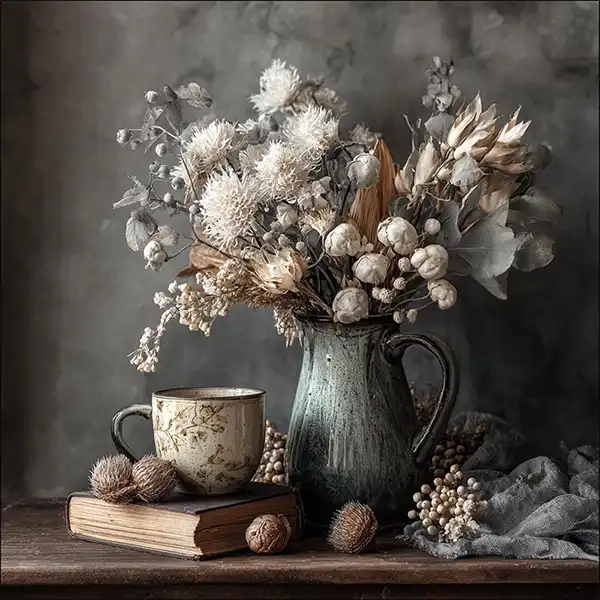
A Still Life: Story ideas inspired by one image
Train your eye — and your imagination — to discover narrative pathways.
This atmospheric image suggests multiple possible story directions. The three story ideas presented explore tonal perspectives of Emergence, Discordant, and Ephemeral, offering creative sparks and story nudges to help you explore different narrative paths.
Curiosity Spark:
A moment too small to matter may be the only one that does.
3 Story Ideas:
Emergence — Transformation
Porcelain Awakening
At first it was only a still life: a book resigned to silence, a cup cooling into its own memory, a pitcher holding the hush of harvested seasons. Yet something in the arrangement had begun to stir—not visibly, not audibly, but with the subtle authority of roots shifting beneath soil. The dried blossoms, pale as forgotten letters, seemed to lean toward one another as though exchanging confidences long withheld. Even the ceramic glaze bore the faintest tremor of light, as if awakening to the realization that it had once been river-clay, once been movement.
The watcher of this tableau—who had arranged it hours ago in a gesture of aesthetic obedience—felt an answering motion within. It was not joy, nor sorrow, but the sensation of a door quietly unlatching somewhere in the corridors of the self. The flowers, preserved past their blooming, appeared to insist that transformation was not a matter of petals but of perception. What if the truest blossoming occurred not when something opened, but when something understood why it had closed?
Discordant — Unease
The Arrangement That Refuses Agreement
At a distance, the composition seemed dutifully harmonious—earth tones in obedient congress, textures rehearsing their roles in a performance of quiet domestic grace. Yet the longer one regarded it, the more it faltered. The cup’s handle tilted not toward comfort but toward refusal. The book’s spine bore a title rubbed deliberately illegible. And the pitcher—green as a forest withheld from maps—held stems whose angles contradicted the laws of gravity with quiet defiance.
It was not disorder that troubled the observer but intention. Someone had constructed this scene with precision, and precision implies motive. The scattered seeds resembled punctuation marks from a sentence erased. The cloth drooped as though recently disturbed. Even the ledge of shadow along the table’s edge suggested concealment. The tableau was not an arrangement; it was a confession that had not yet decided what it was confessing.
Ephemeral — Fleeting Beauty
Minute of Dustlight
For one breath alone, a filament of sunlight entered through an unseen aperture and rested upon the rim of the cup. It was so slight a visitation that it might have been mistaken for imagination, yet in that instant the porcelain glowed with the fragile authority of a moon glimpsed through fog. A single dust mote drifted through the beam, hesitated, and then vanished as if recalled by an unseen curator of moments.
No one else in the house noticed. No clock acknowledged it. Yet the witness understood with a sudden, piercing clarity that this vanishing particle possessed more urgency than entire years. The flowers would persist in their preserved hush, the book in its patient silence—but that mote, that trembling speck of brightness, had already lived and concluded a history no archive would keep. The tragedy was not that it disappeared; it was that its disappearance would never be mourned.
Story Nudge:
-
What faint scent rises from the dried flowers, and why does it feel strangely familiar—almost like a memory rather than a smell?
-
Which object in the arrangement seems subtly misplaced, as though it were added after the scene was finished?
-
What passage lies hidden beneath the cup’s weight inside the closed book, and who didn’t want it read?
-
If one tiny detail were to vanish in the next minute—a seed, a mote of dust, a sliver of light—which loss would matter most, and why?
-
Who last touched this arrangement, and what private thought were they trying to quiet when they did?
-
Why does the scene feel less like decoration and more like evidence?